
Skip to content
Species Guide

Know Your Bees

Over 20,000 bee species exist worldwide — and roughly 4,000 are native to North America. Here are the species you're most likely to encounter in Sacramento and beyond.

Featured Species

The world's most important managed pollinator

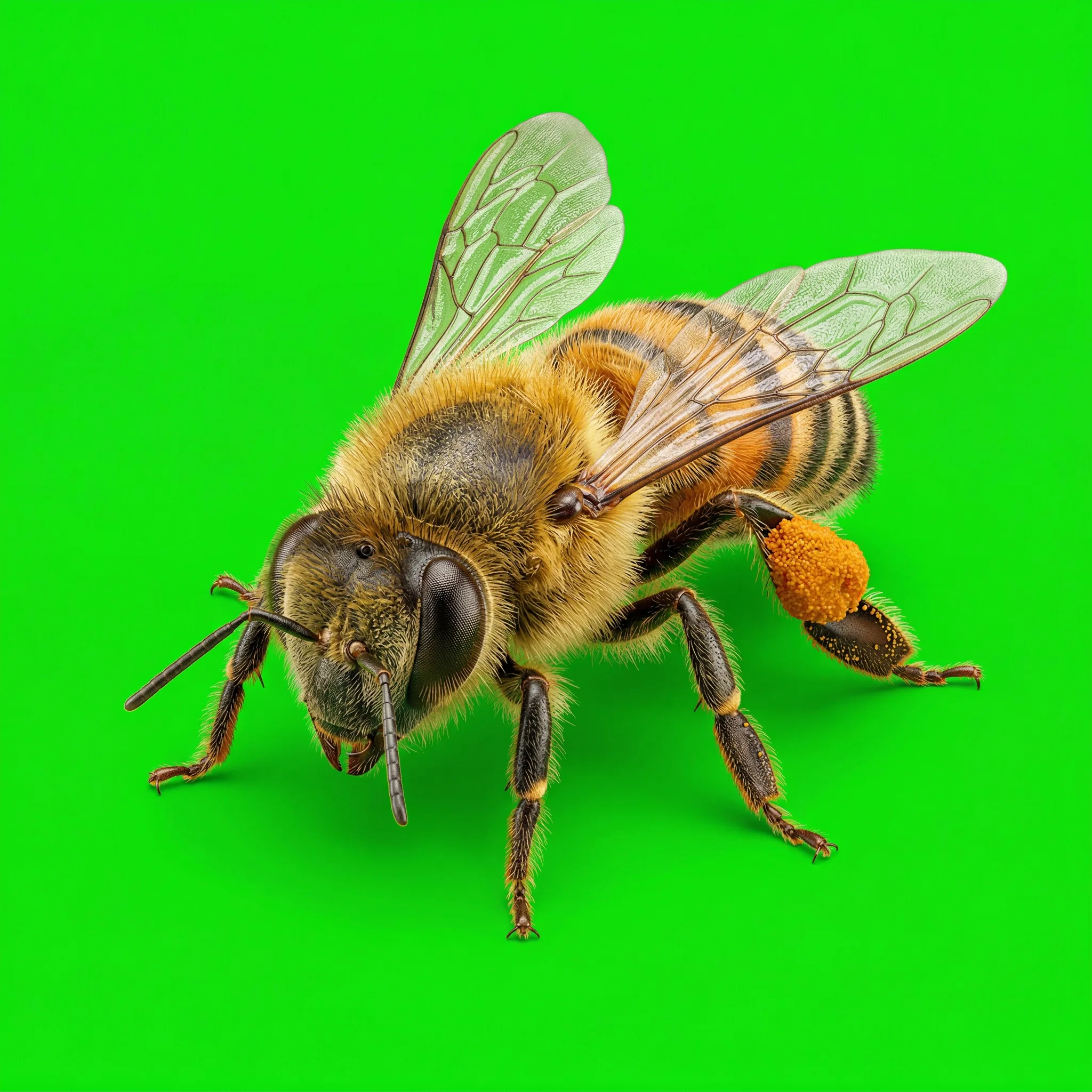
3D render of a Western honey bee (Apis mellifera)

Apis mellifera is the single most economically significant pollinator on Earth — responsible for roughly $15 billion in U.S. crop value annually. Originally native to Europe, Africa, and the Middle East, this species now occupies every continent except Antarctica through centuries of human management.

20,000–80,000

Colony Size

3–5 miles

Foraging Range

~28 subspecies

Species Known

5–6 weeks

Lifespan (Worker)

A single queen lays up to 2,000 eggs per day. Worker bees — all female — cycle through nursing, wax building, guarding, and foraging roles over their 5–6 week lifespan. Drones (males) exist solely to mate with virgin queens and are expelled from the hive before winter.

Honeybees use the "waggle dance" to share the direction and distance of food sources with nestmates — one of the most complex forms of non-primate communication studied. They also use pheromones to coordinate swarming, alarm response, and queen recognition.

Varroa destructor mites remain the single largest threat to managed colonies worldwide. These parasites weaken bees directly and transmit deformed wing virus, acute bee paralysis virus, and other pathogens. Combined with pesticide exposure, habitat loss, and poor nutrition from monoculture agriculture, U.S. beekeepers lost over 48% of managed colonies in 2023–2024.

California's almond industry depends on 2.5 million honeybee colonies trucked in every February for pollination. The Sacramento Valley sits at the center of this operation, making local colony health a regional economic issue — not just an environmental one.

Native Species

The wild bees you should know

Honeybees get the headlines, but native bees do the heavy lifting. These species pollinate 80% of flowering plants and require no management — just habitat.

Bumblebees

Bombus spp.

Fuzzy, ground-nesting powerhouses of native pollination

Bumblebees form small annual colonies of 50–500 workers, usually nested underground in abandoned rodent burrows. Their large, fuzzy bodies and ability to "buzz pollinate" — vibrating flight muscles at a specific frequency to shake pollen loose — make them irreplaceable for crops like tomatoes, blueberries, and peppers that honeybees cannot efficiently pollinate.

Several North American bumblebee species, including the rusty patched bumblebee (Bombus affinis), have been federally listed as endangered — the first bee to receive that designation in the continental U.S.

  • Buzz pollination specialist
  • Flies in cooler temperatures
  • Ground-nesting colonies
  • Annual lifecycle (queen overwinters alone)

Carpenter Bees

Xylocopa spp.

Large, solitary wood-boring bees often mistaken for bumblebees

Carpenter bees are solitary nesters that bore circular tunnels into untreated wood — decks, fascia boards, and fence posts. Despite their size and loud buzzing, they are docile. Males are territorial but stingless; females rarely sting unless directly handled. Their tunneling can cause cosmetic damage to structures but poses no structural risk in most cases.

Unlike termites, carpenter bees do not eat wood. They excavate nesting galleries, push out the sawdust (frass), and provision each cell with a pollen ball before laying an egg.

  • Solitary nester
  • Bores into untreated wood
  • Males cannot sting
  • Important native pollinator

Mason Bees

Osmia spp.

Early-season cavity nesters — 100x more efficient than honeybees per bee

Mason bees emerge in early spring before honeybee colonies reach full strength, making them critical pollinators for fruit trees, berries, and early-blooming crops. They nest in pre-existing holes — hollow stems, beetle tunnels, or "bee hotels" — sealing each egg chamber with a mud partition. A single mason bee can pollinate as many flowers as 100 honeybees due to their messy, full-body pollen collection.

Blue orchard mason bees (Osmia lignaria) are now commercially managed for orchard pollination as a supplement to declining honeybee availability.

  • Solitary cavity nester
  • Seals nest cells with mud
  • Active in cool spring weather
  • Exceptional pollination efficiency

Mining Bees

Andrena spp.

Ground-nesting specialists — one plant, one purpose

Andrena is one of the largest bee genera, with over 1,500 species worldwide. Many are oligolectic — they collect pollen from only one plant genus or family. These ground-nesting solitary bees dig vertical burrows in bare or sparsely vegetated soil, often forming dense aggregations that homeowners mistake for wasp infestations. They are completely non-aggressive.

Mining bee aggregations can contain thousands of individual burrows in a single patch of ground, yet each female provisions her own nest independently. They pose zero stinging risk to humans or pets.

  • Ground-nesting solitary bee
  • Often plant-specialist (oligolectic)
  • Non-aggressive
  • Largest bee genus by species count

Sweat Bees

Halictidae family

Tiny metallic bees attracted to human perspiration

Sweat bees are among the most common native bees in North America — and one of the most overlooked. Many species display brilliant metallic green, blue, or copper coloring. They nest in the ground or in rotting wood, and some species are "primitively eusocial," meaning a single female may share a nest entrance with her daughters while each provisions her own cells.

Despite their name, sweat bees are gentle pollinators. Their attraction to human sweat is driven by salt needs, and their sting — if provoked — is one of the mildest of any bee.

  • Metallic coloring (green, blue, copper)
  • Ground or wood nesting
  • Some primitively eusocial species
  • Among smallest native bees
Why Identification Matters

Different bees need different responses

A honeybee swarm on your porch needs professional relocation. A carpenter bee in your deck beam needs a different approach. Mining bees in your lawn need nothing at all — they'll be gone in three weeks. Knowing what you're looking at prevents unnecessary pesticide use and protects species that are already in decline.

01

Identify

Use size, nesting behavior, and location to determine which bee you're dealing with. Most "bee problems" are actually harmless native species.

02

Assess

Honeybee swarms are temporary and usually relocate within 48 hours. Established colonies in structures need professional help. Ground-nesting bees are seasonal.

03

Act Appropriately

Report honeybee swarms for free removal. Leave ground-nesting bees alone. Paint or seal exposed wood to deter carpenter bees. Never spray without identification.

Need Help?

Not sure what you're looking at? We'll help.

Send us a photo and we'll identify the species, assess the situation, and recommend next steps — free of charge across 30+ Sacramento-area cities.